How to Sell Notes Online in India (2026 Guide)
How to sell notes online in India: what sells for each exam, what to charge, a notes marketplace or your own store, and how students pay by UPI and get the PDF instantly.
FunnelPe Team · 06 Nov 2026 · Updated 10 Nov 2026 · 10 min read

If you cleared an exam, topped your class or teach a subject, you can sell notes online to the students coming after you. Good notes save them months, and that's worth paying for. This guide covers what sells for which exam, what to charge, how to turn handwritten pages into a clean PDF, whether to use a notes marketplace or your own store, and how to set up a store where students pay by UPI and get the file instantly, even while you're asleep.
How to sell notes online in 5 steps
- Pick one exam and one subject you know best.
- Turn your notes into a clean, branded PDF (scan or type).
- Price it: ₹49 a chapter, ₹149–₹299 a subject, ₹399–₹699 a full bundle.
- Put it on a sales page with UPI checkout and instant delivery on WhatsApp and email, or list it on a notes marketplace.
- Give one chapter free, and share it where your students already are.
What notes sell, by exam
Students pay for notes that save time before a specific exam. The more specific, the easier to sell.
| Exam | What sells | Format | Suggested price |
|---|---|---|---|
| UPSC Civil Services | Subject short notes (Polity, Economy, Modern History), current affairs compilations, answer-writing frameworks | PDF, monthly updates | ₹149–₹499 |
| State PSCs | State-specific GK, history and economy notes | ₹99–₹299 | |
| SSC / Banking | Formula sheets, shortcut tricks, vocabulary lists, previous-year question (PYQ) sets | ₹49–₹199 | |
| NEET / JEE | Chapter-wise revision notes, formula and reaction sheets, mind maps | ₹99–₹399 | |
| CBSE Class 10 / 12 | Last-month revision notes, sample paper solutions | ₹49–₹199 | |
| CA / CS | Summary notes, amendment updates, charts | ₹199–₹699 |
How much to charge
- ₹49 for a single chapter or formula sheet. An easy first purchase.
- ₹149–₹299 for a full subject. Your main product.
- ₹399–₹699 for a complete bundle of all subjects, with updates.
- Add a ₹49 order bump at checkout, such as a 10-year PYQ set or a formula sheet. A good share of buyers tick it, and it costs you nothing extra to deliver.
- Show a "was" price only if it's real. A launch price that goes up after the first 100 students is honest and works.
For more on pricing, read how to price your course in India. The same ideas work for notes.
Turn handwritten notes into a clean PDF
- Scan with your phone. The scan option in the Google Drive app or Adobe Scan straightens pages and boosts contrast. Scan in daylight, flat on a table.
- Merge into one PDF per subject, in order, with a contents page.
- Add a cover and your name on every page: a small footer such as "StudyDesk · Polity notes · for personal use only".
- Keep it light. Compress to under 20–30 MB so it opens fast on a phone.
- Typed notes? Google Docs or Canva export straight to PDF. Use big headings and short points. Students read these on phones.
Where to buy and sell notes online: marketplace or your own store
There are two ways to sell notes online. You can list them on a notes marketplace, a website where many sellers upload notes and students search, buy and download them. Or you can sell from your own store: your own sales page and checkout link, which you share with the students who already follow you.
| Notes marketplace | Your own store | |
|---|---|---|
| Where buyers come from | Students already browsing the marketplace, plus anyone you send there | You: your Telegram, YouTube, Instagram and WhatsApp |
| Fee | A share of every sale, set by the marketplace | A payment fee per sale (4% + GST on FunnelPe) |
| Your page | A listing next to other sellers' notes | Your own page, with only your notes on it |
| Getting paid | Usually your earnings build up as a balance, and you request a payout once it crosses a minimum | Each payment goes to your payment account (your own Razorpay account on FunnelPe) |
| Rules | The marketplace approves listings and sets the terms | You decide the price, bundles and offers |
| Selling to the same students again | Depends on which buyer details the marketplace shares with you | Easy: you have each buyer's email and WhatsApp number |
A real example: CraftedDocs, an Indian notes marketplace, gives sellers 80% of each sale with no listing or monthly fee. Once your balance reaches ₹100 you can request a payout to UPI or a bank account, which takes 2–5 business days, per its seller page on 10 Nov 2026. On a ₹199 PDF that's about ₹159 to you. Some international notes sites set their payout minimum in euros or dollars, so check that a site pays out to an Indian bank account before you upload.
Which should you choose?
A marketplace is a quick way to test whether students will pay for your notes before you have an audience. Once you have one (a Telegram channel, a YouTube channel, or juniors who keep asking for your notes), your own store keeps more of each sale (₹190 of every ₹199 on FunnelPe, see the table below) and lets you sell your next edition to the same students. You can use both, as long as the marketplace's terms allow you to sell the same notes elsewhere.
Buying notes? What to check
Buy from the author's own page or from a marketplace with reviews, look at the sample pages first, and check that the notes match your exam and year. Free "PDF" forwards of paid notes on Telegram are pirated copies: they don't get updated editions, and the person who wrote them earns nothing.
Where to sell: what you keep on a ₹199 PDF
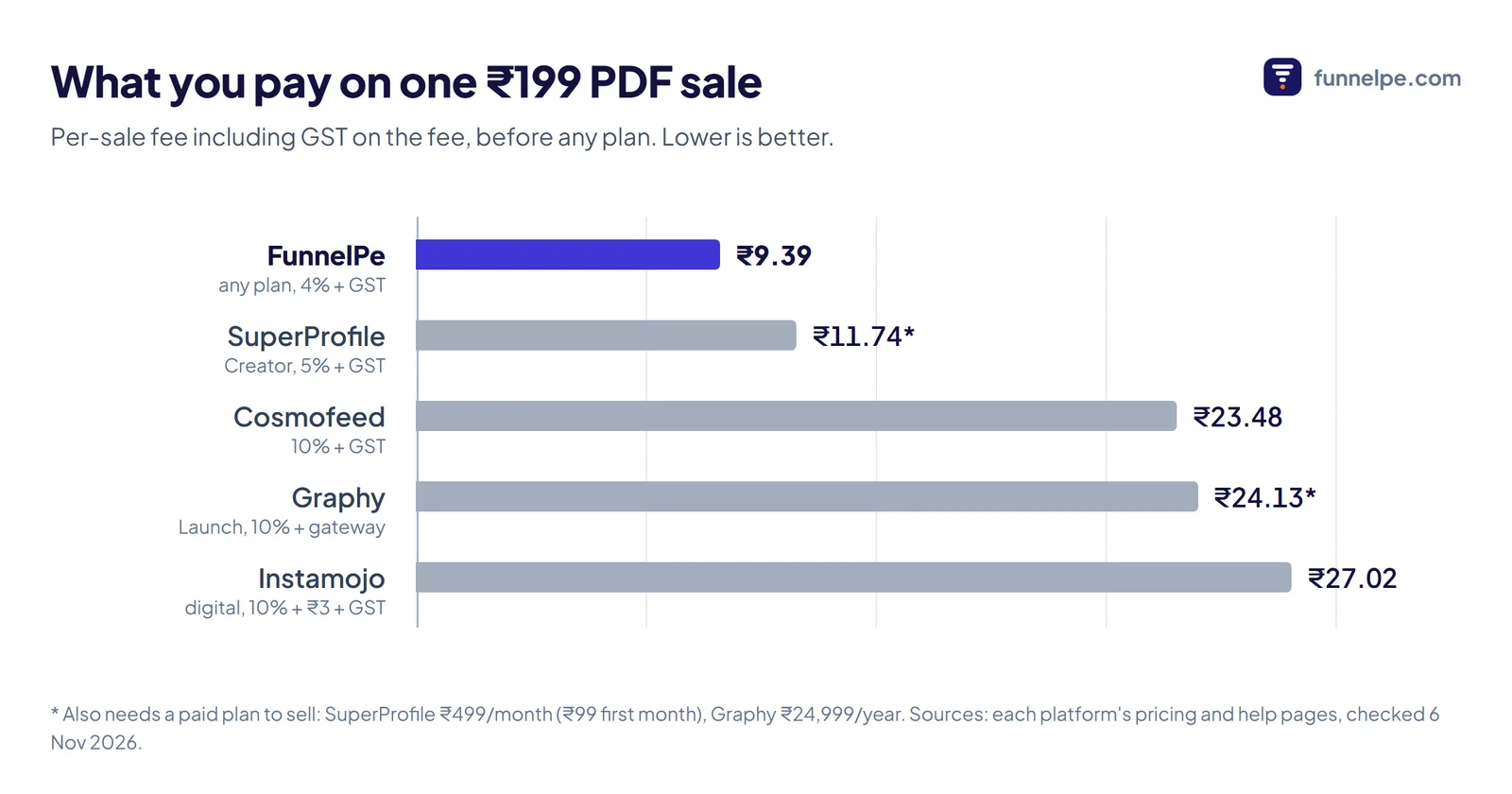
| Option | You keep on ₹199 | Plan to sell | Who owns the buyer list |
|---|---|---|---|
| FunnelPe | ₹190 | ₹0 | You (into your own Razorpay) |
| SuperProfile | ₹187 | ₹499/month (₹99 first month) | You, via the platform |
| Cosmofeed | ₹176 | ₹0 | You, via the platform |
| Graphy | ₹175 | ₹24,999/year | You, via the platform |
| Instamojo | ₹172 | ₹0 (Lite) | You, via the platform |
| Selling in DMs by UPI screenshot | ₹199 | ₹0 | Nobody: no list, no invoices, no automation |
Selling through DMs keeps every rupee, but you'll spend your evenings checking screenshots and sending files by hand, and fake screenshots are common. A store does that work for you for a few rupees a sale, and FunnelPe keeps the most of any store we compared: ₹190 of every ₹199, with ₹0 to pay each month. For a detailed comparison of these platforms, see our SuperProfile alternative guide.
UPI payments in India in October 2026 alone (NPCI). Your students already pay by UPI every day; a ₹199 checkout is nothing new to them.
Set up your notes store (about 20 minutes)
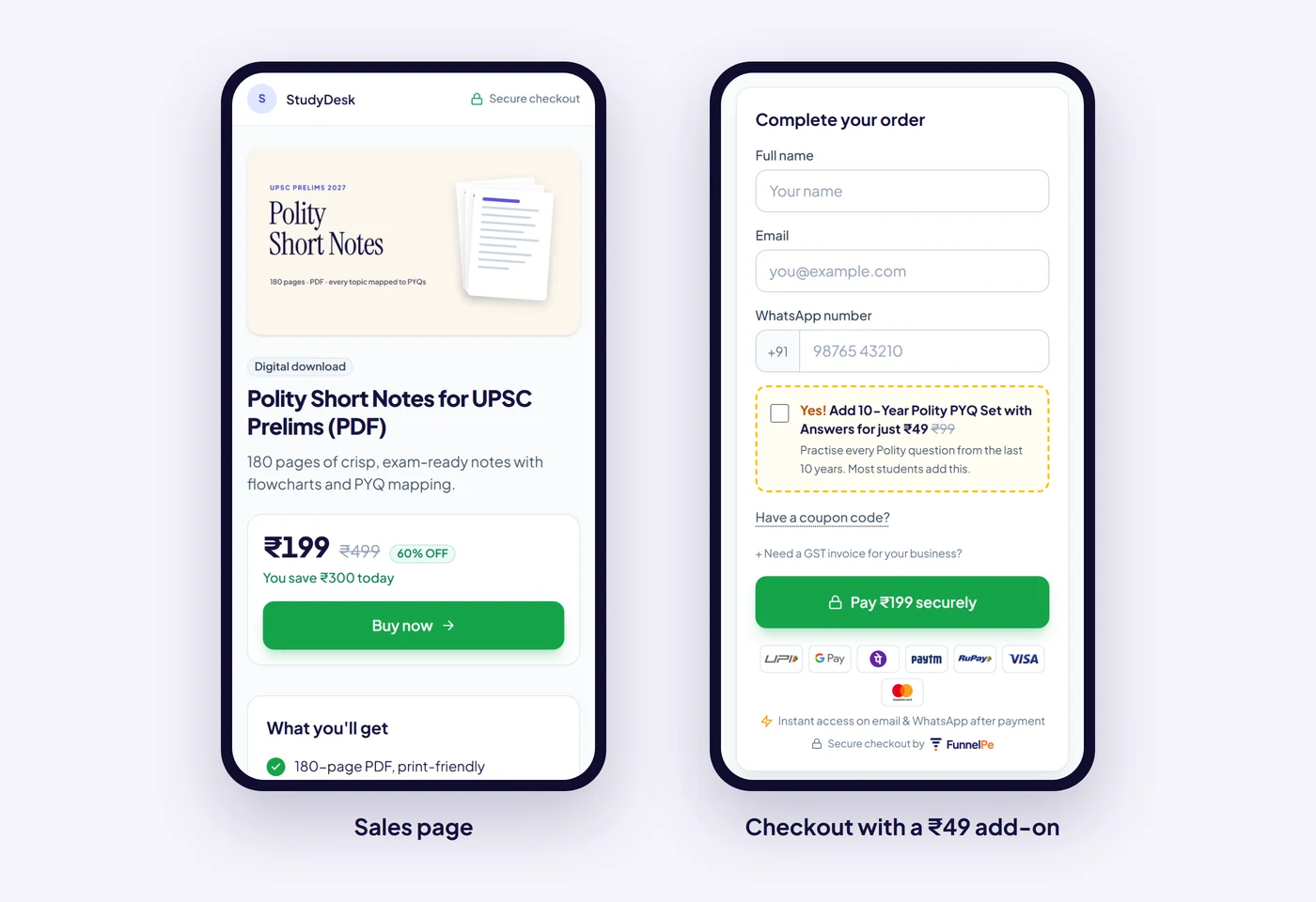
- Create a free account and connect your Razorpay account (Razorpay verifies your PAN, Aadhaar and bank, usually within a few working days).
- Add a "Digital download" product and upload the PDF.
- Write the page: a title with the exam and year, 3 highlights ("180 pages", "every topic mapped to PYQs", "free updated edition"), 2–3 sample page images, and an FAQ.
- Set the price and add your PYQ set as a ₹49 order bump.
- Share your link in your bio, Telegram channel, YouTube description and WhatsApp status.
When a student pays, they get the PDF instantly on email and WhatsApp, plus a GST invoice. It also stays in their library to download again. You get a notification and the money goes to your own Razorpay account.
Keep ₹190 of every ₹199
Upload your notes, set a price and share one link. Free to start, no card needed.
Start selling my notesHow to stop notes being forwarded
Honestly, you can't stop it completely. Any PDF can be forwarded. What you can do is make your paid copy more valuable than a pirated one:
- Brand every page with your name and "for personal use only". A forwarded copy then advertises you.
- Release updated editions. Buyers get the new version; forwarded copies go out of date.
- Sell what can't be forwarded: a doubt-solving group, a test series or a monthly membership alongside the notes.
- Give a free sample, so students don't go hunting for a pirated copy just to check quality.
- Report pirated copies. Telegram takes copyright complaints at [email protected].
Getting your first 50 buyers
- Give one chapter free. Make it a ₹0 product. Students leave their email and WhatsApp to get it, and you can tell them when the full notes are ready.
- Go where your students are: exam Telegram channels, WhatsApp study groups, Reddit and Quora answers on that exam.
- Post short videos explaining one PYQ or one tricky topic, with your link in the description.
- Turn toppers into partners. Give senior students an affiliate link and a commission on every sale they bring.
- Time it with the exam calendar. Sales peak in the 6–8 weeks before an exam. Launch before that.
Want a full first-sale plan? Read how to sell your first digital product in India.
GST and copyright basics
- GST: you don't need a GST number to start. Registration generally becomes compulsory once yearly turnover from services crosses ₹20 lakh (₹10 lakh in some states). Ask a CA about your own case.
- Sell only your own work. Notes written in your own words, from your own understanding, are yours to sell.
- Don't copy books or coaching material. Scanning textbook pages, NCERT text or a coaching institute's printed notes and selling them is copyright infringement, even if you rearrange them.
- PYQs: past questions are public, but your solutions and explanations are what you're selling, so write them yourself.
This is general information, not legal advice.
Short mein: notes bech kar paise kaise kamaye
Ek exam aur ek subject choose karo jisme aap strong ho. Apne notes ko clean PDF bana lo, har page pe apna naam daalo. Price rakho ₹49 ek chapter, ₹149–₹299 poora subject. Checkout pe ₹49 ka PYQ set add-on rakho. Apni store link Telegram, WhatsApp aur YouTube pe share karo, aur ek chapter free do. Student UPI se pay karega aur PDF turant WhatsApp aur email pe mil jayega. Aapko screenshots check nahi karne padenge.
Frequently asked questions
Can I sell handwritten notes online in India?
Yes. Scan them into a clean PDF, add your name to every page, and sell the PDF from your own store with UPI checkout or on a notes marketplace. On your own store, students get the file instantly after paying.
How do you buy and sell notes online?
The seller turns their notes into a PDF and either lists it on a notes marketplace or sells it from their own store link. The buyer pays online (in India, usually by UPI) and downloads the file straight away. If you're the buyer, check the sample pages, the exam year and the reviews before you pay.
Where can I sell my notes online in India?
You have two options: a notes marketplace, which brings some buyers to you but keeps a share of each sale (CraftedDocs, for example, gives sellers 80%), or your own store, where you bring the buyers and keep more of each sale (₹190 of every ₹199 on FunnelPe). If students already follow you on Telegram, YouTube or Instagram, your own store usually makes more sense.
How much should I charge for PDF notes?
Most sellers charge ₹49 for a single chapter, ₹149–₹299 for a full subject and ₹399–₹699 for a complete bundle. Professional exams like CA can go higher. Start lower, then raise the price as reviews come in.
Is it legal to sell notes based on NCERT or coaching material?
Selling notes you wrote yourself, in your own words, is fine. Copying or scanning NCERT textbook pages or a coaching institute's material and selling it is copyright infringement. This is general information, not legal advice.
How does the student get the PDF after paying?
On FunnelPe, the student gets a download link on email and WhatsApp the moment the payment is confirmed, and the file stays in their library to download again later.
Do I need GST to sell notes?
Not to start. GST registration generally becomes compulsory once your yearly turnover from services crosses ₹20 lakh (₹10 lakh in some states). Ask a CA about your own case.
How do I stop students sharing my notes?
You can't stop it completely, but you can reduce it: put your name on every page, release updated editions only for buyers, give a free sample, and sell things that can't be forwarded, such as a doubt group or test series.
Sources
- Platform fees: SuperProfile, Cosmofeed, Graphy, Instamojo, FunnelPe (checked 6 Nov 2026)
- Notes marketplace example: CraftedDocs seller page (checked 10 Nov 2026)
- UPI usage: NPCI UPI statistics